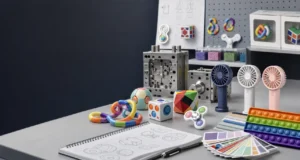
Quick answer: A useful 3D-printing RFQ should identify the exact file version, overall dimensions, quantity, intended use, material route, critical fit features, visible surfaces and deadline. The same printed prototype can then be used to decide whether the design needs another revision, a short printed batch or a later mold-based production route.
This checklist is written for buyers using Jinyu Novelty’s in-house Bambu Lab P1S FDM/FFF service as well as product-development teams preparing a prototype before conventional tooling.
1. Start With the Correct File and Revision
Do not send several similarly named files without identifying which one controls the quotation. Record the file name, revision/date and whether the geometry is final or still being evaluated.
- STL / 3MF: useful for print geometry when the exported model is already correct.
- STEP / STP: useful when dimensional or engineering review may require a solid-model reference.
- OBJ or another export: can be reviewed when appropriate to the geometry and project.
- No print-ready file: send the sketch, photo, dimensions or physical-reference description and state that modeling/engineering support must be reviewed separately.
Jinyu does not assume that a photo or sketch is already a production-ready 3D model.
2. Define What the Printed Part Must Prove
| Prototype goal | What to review | What the print does not automatically prove |
|---|---|---|
| Visual concept | Overall shape, proportions, presentation and handling | Final molded surface or production-material behavior |
| Fit check | Mating faces, holes, clearances and assembly relationship | Mass-production tolerance without a separate production specification |
| Functional prototype | Movement, component space, interfaces and intended handling | Certified strength, fatigue life or safety performance |
| Buyer / market sample | Size, appearance, product idea and packaging/display role | That the printed method is the final economic production route |
| Bridge batch | Short-run usability and controlled repeat production | That printing remains economical when order volume grows substantially |
3. Mark Critical Dimensions and Assembly Features
Overall length, width and height are not enough when the part has functional interfaces. Identify the dimensions that matter to fit or use.
- Hole diameters and center-to-center spacing.
- Mating faces and insertion depth.
- Snap, clip, tab or locating features.
- Threads or inserts that require a specific assembly route.
- Clearance around electronics, batteries, motors or other components.
- Surfaces that must align with another physical part.
Do not apply one universal tolerance to every feature. Critical dimensions should be identified before the print and acceptance method are agreed.
4. Tell the Supplier Which Surfaces Matter
FDM/FFF parts are affected by print orientation, supports and visible layer direction. If a face is cosmetic, customer-facing or must mate with another part, mark it before quotation rather than after the part is printed.
- Primary visible surface.
- Support-sensitive surfaces.
- Logo or label area.
- Assembly interfaces.
- Areas that may require basic post-processing.
5. Choose PLA or PETG by the Actual Use
Jinyu’s current commonly used P1S materials are PLA and PETG. Material should be selected against the real project rather than assuming one filament is universally better.
| Current route | Typical review question |
|---|---|
| PLA | Is the priority a concept model, visual prototype, display piece or suitable indoor non-safety-critical part? |
| PETG | Does the part need a different balance of handling, toughness or functional use than a primarily visual prototype? |
Neither material is automatically approved for child-use, food-contact, high-temperature, structural, outdoor or regulated applications. State the end use so the practical route can be reviewed.
6. Include Quantity and the Next Volume Step
Quantity affects more than price. It helps determine whether the project should stay on the P1S route or whether another manufacturing method deserves review.
- One or a few parts: prototype or design validation.
- Short batch: buyer test, exhibition, pilot use or low-volume custom requirement.
- Bridge production: temporary printed supply before tooling or another process is ready.
- Higher repeat volume: compare the economics of conventional tooling or another manufacturing route.
There is no single quantity at which injection molding automatically becomes cheaper. Part size, complexity, tooling requirement, expected repeat demand and product life all affect the decision.
7. Prototype-to-Mold Review
A 3D printed prototype and an injection-molded production part are different manufacturing outputs. Before releasing a mold, buyers should record which parts of the printed design are approved and which still need production engineering.
| Before mold review | Decision to record |
|---|---|
| Geometry | Which dimensions and interfaces are frozen? |
| Part split | Will the production design remain one piece or change into several molded parts? |
| Material | What production material and performance requirements replace the prototype filament? |
| Assembly | How will parts, inserts, fasteners or electronics be assembled? |
| Appearance | Which surfaces, texture, color and branding requirements control the production sample? |
| Testing | What destination, intended-user or product-specific requirements apply after the final production configuration is defined? |
For deeper product development, see OEM/ODM Toy & Custom Product Development.
8. Copy-Ready 3D Printing RFQ Checklist
- Company / contact:
- File name and revision:
- File format:
- Overall dimensions:
- Quantity now:
- Expected repeat quantity:
- End use:
- PLA / PETG preference if known:
- Critical dimensions / mating features:
- Visible or finish-sensitive surfaces:
- Color / finish requirement:
- Assembly requirement:
- Destination country / postal code:
- Required arrival date:
- Future mold / mass-production plan:
9. What Jinyu Reviews Before Quotation
Jinyu’s verified in-house route uses a Bambu Lab P1S for selected FDM/FFF prototypes and low-volume projects. The nominal build volume is 256 × 256 × 256 mm, with PLA and PETG as the current commonly used materials. Actual printable geometry, orientation, supports, finish, dimensional acceptance and batch output are confirmed against the exact file and project.
This checklist does not represent Jinyu as a certified medical, aerospace, dental or other safety-critical additive-manufacturing service.
Request a File Review
Use the 3D Printing RFQ to submit quantity, dimensions, intended use, critical features, destination and deadline, then send the file through the stated attachment route.
3D Printing Service · Sampling & Quality Control · Prototype to OEM/ODM