
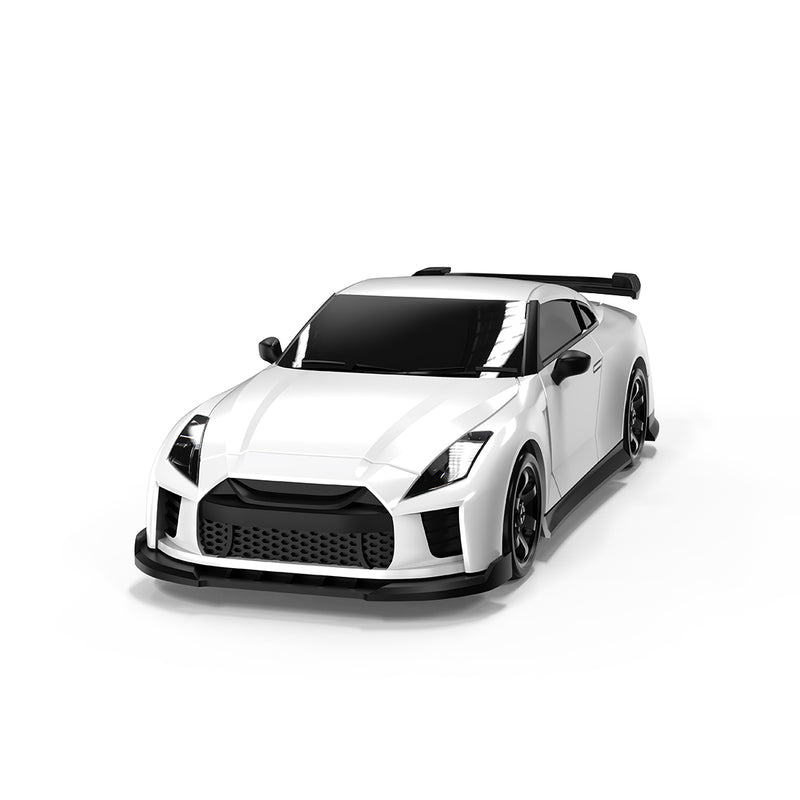
Quick answer: sourcing an RC car is not the same as buying a simple plastic toy. A reliable quotation should freeze the exact vehicle model, radio/controller system, battery and charging configuration, working functions, package contents, intended market, sample, compliance evidence and QC checkpoints before price comparisons are treated as comparable.
Jinyu Novelty uses this guide for buyers evaluating remote-control toys from the Chenghai supply chain. It is a sourcing and qualification framework, not a claim that every RC model is manufactured in-house or that one supplier document applies across multiple vehicles.
1. Start with the RC buyer intent, not a generic “RC car” request
Different RC categories create different purchasing risks. The current Jinyu RC architecture separates the following routes because the buyer decisions are materially different:
| Route | Main buying decision | Typical sample focus |
|---|---|---|
| RC stunt car | Flip/rotation/tumbling or transformation mechanism | Repeated stunt durability, pairing, wheel/gear retention |
| Mini RC drift car | Scale, steering angle, tire setup and actual drift behavior | Steering response, tire fit, indoor-surface handling |
| 4WD off-road RC | Actual drivetrain, tires, suspension and terrain expectation | 4WD engagement, axles, wheel retention, terrain test |
| RC crawler | Low-speed control, gearing, torque, articulation and parts support | Climbing/control behavior, steering, suspension |
| RC excavator / dump truck | Working construction functions and function count | Boom/arm/bucket or dump-bed operation and repeatability |
| Gesture-control RC | Alternative controller, pairing logic and response consistency | Wrist/gesture response, conventional remote if included |
| Amphibious RC | Verified land/water function and sealing design | Actual water operation, sealing, drying/maintenance instructions |
2. Freeze the exact model before comparing quotations
Two vehicles that look nearly identical can use different transmitters, motors, gearboxes, batteries, chargers or package contents. Before price comparison, record at least:
- Supplier and exact model / SKU reference.
- Vehicle scale or dimensions.
- Drive system: 2WD, 4WD or other verified arrangement.
- Controller type and radio system/frequency.
- Vehicle battery chemistry, capacity and connector.
- Controller battery requirement.
- Charging cable, charger or adapter included in the set.
- Verified functions: speed, lights, sound, stunts, construction movements or water operation.
- Included accessories and spare parts.
- Retail box, manual, warnings, barcode/SKU and destination-market labeling.
A quotation without those fields may be cheaper simply because it describes a different configuration.
3. Use a working sample, not only a photo sample
For RC products, a physical sample should be powered, paired and operated. A useful approval record can include:
- Pairing and controller response.
- Forward/reverse/steering or all advertised functions.
- Repeated-use function test.
- Wheel, axle, gear, hinge or moving-part retention.
- Battery charging and practical runtime observation.
- Controller range in the intended environment.
- Multi-unit interference check where several cars may operate together.
- Pack-out: vehicle, controller, batteries, cable/charger, accessories and instructions.
If a buyer changes the vehicle model after approval, the sample and document set should be reviewed again.
4. Radio and controller details belong in the commercial specification
Do not use “2.4G”, “long range” or “anti-interference” as generic marketing language unless it is verified for the selected model. The RFQ should identify the controller and radio arrangement actually supplied. For U.S. and EU programs, the radio system can also affect the compliance route, so the exact transmitter/receiver configuration should stay tied to the test evidence.
5. Battery and charging details affect both product quality and logistics
Battery questions belong at the beginning of the RC sourcing process, not after production. Confirm whether the vehicle uses disposable cells, rechargeable lithium cells/batteries or another system; whether the battery is installed, packed with the vehicle or shipped separately; what charging accessory is included; and what transport documents are available for the exact battery.
For lithium-battery products, buyers should ask for the applicable battery identification and transport evidence such as the relevant UN 38.3 test summary when required. Air-shipping rules can differ depending on whether batteries are installed in equipment, packed with equipment or shipped separately.
6. Separate private-label work from deeper OEM/ODM
| Route | Typical scope |
|---|---|
| Existing-product private label | Box artwork, label, insert, manual, barcode/SKU, selected color or approved product logo |
| Product modification | Accessory, color/material, electronics or function change requiring supplier engineering review |
| Deeper OEM/ODM | New shell/tooling, controller design, electronics, mechanism or major performance change |
Do not quote a new shell or electronics change as if it were only a packaging job. Tooling, sample cycles, ownership and compliance scope can change materially.
7. Qualify the supplier route, not only the product photo
For a serious RC program, supplier review should answer:
- Who owns or controls the selected model and tooling?
- Is the exact model currently in production?
- Can the supplier reproduce the approved radio/battery configuration?
- What QC is performed on pairing, function and charging?
- Which test reports or declarations correspond to this exact configuration?
- Are replacement parts or batteries available where commercially important?
- Can packaging, manuals and warning labels be controlled by revision?
Jinyu’s role may combine direct project control with a specialist RC factory route; the supplier identity and evidence should remain attached to the model rather than hidden behind a generic “factory-direct” statement.
8. Build RC-specific QC checkpoints
A basic visual AQL inspection is not enough for a function-led RC product. Depending on model and order size, the inspection plan can include:
- Sample-based appearance and pack-out checks.
- Controller pairing and function test.
- Drive/steering or mechanism cycle checks.
- Battery and charging spot checks.
- Wheel/axle/accessory retention.
- Sound/light or special-effect confirmation.
- Instruction, warning and barcode/SKU verification.
- Carton quantity and shipment-mark checks.
9. Send an RFQ that can produce a comparable answer
For an RC sourcing request, send the reference image or vehicle type, target market, intended user, opening quantity, target retail or purchase price if available, required functions, battery preference, branding/packaging requirements and required arrival date. If a reference product has a known scale, controller type or battery, include those details too.
10. Current Jinyu RC sourcing architecture
Jinyu currently publishes eight buyer-visible RC sourcing routes: stunt car, mini drift car, 4WD off-road car, crawler, excavator, dump truck, gesture-control stunt car and amphibious car. Pages without a frozen exact supplier model and authorized product media remain noindex until verification. This prevents a keyword page from being mistaken for a physically approved SKU.
Frequently Asked Questions
What is the MOQ for RC cars from China?
There is no category-wide MOQ. It depends on the exact model, supplier, packaging, battery configuration, branding and whether the project uses an existing product or requires modification.
Can I private-label an existing RC car?
Often, yes, through packaging, labels, inserts, manuals, barcodes and selected model-specific product branding. Exact options must be confirmed with the selected supplier/model.
Should I ask for CE, FCC or ASTM reports before choosing the model?
Ask what evidence exists, but verify that it belongs to the exact model and configuration. A report from a similar RC car should not be treated as automatic proof for another vehicle.
Can Jinyu source an RC model that is not in the current catalog?
Yes. Send a reference image, target specification or retail position. Jinyu can use Chenghai supplier routes to shortlist models, then confirm samples, documents, packaging and QC before treating one as buyer-ready.
Remote Control Toys Wholesale & RC Car Sourcing Hub → · Browse the RC catalog → · RC compliance & battery checklist →